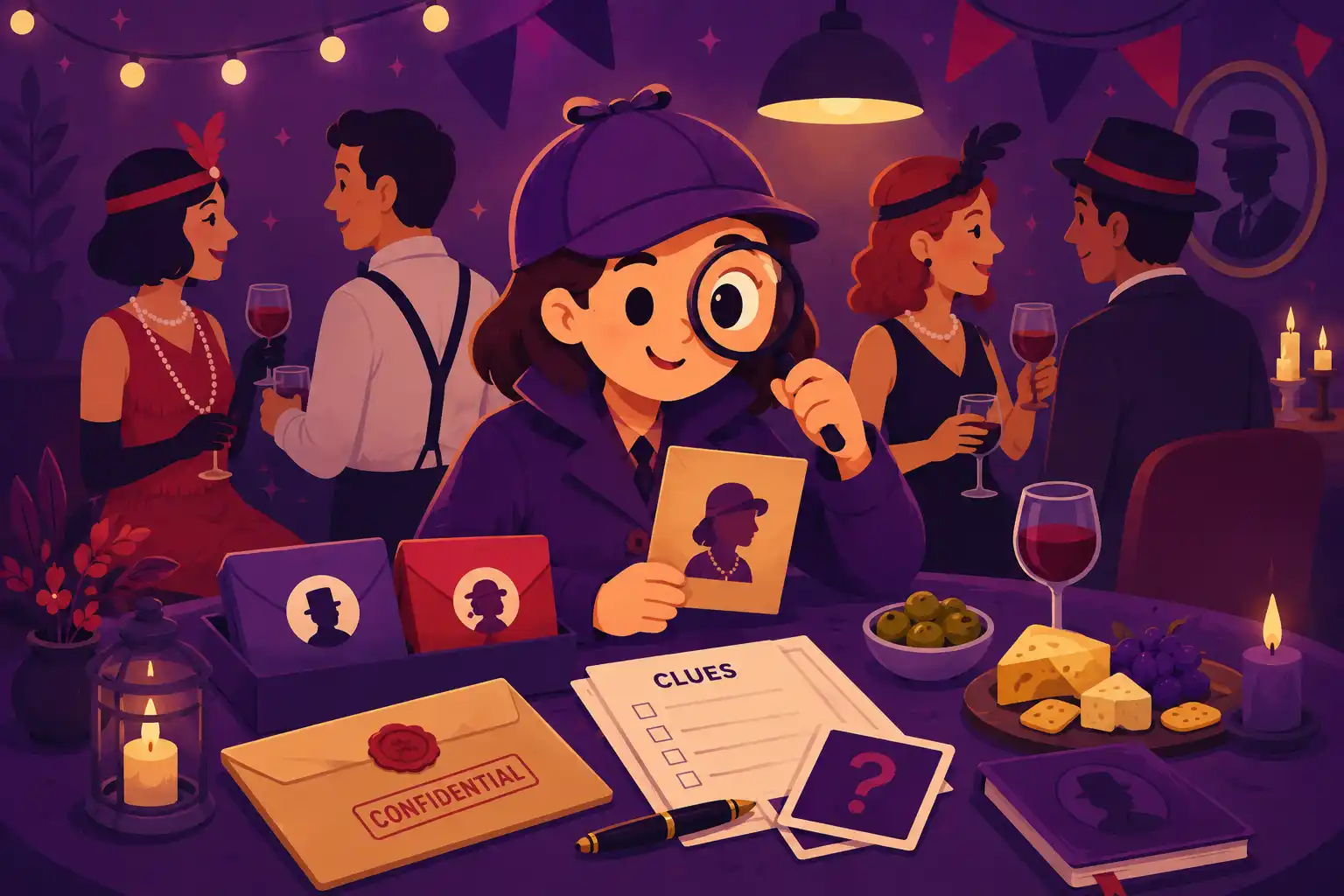

Someone’s been ‘murdered’. The suspects are circling. Accusations start flying. Secrets spill out. The energy in the room builds.
Then, at the final reveal, everyone realises the truth could never have been deduced from the clues provided.
That’s the moment a mystery game collapses.
The best murder mystery games don’t rely on shock twists or withheld evidence. They reward attention. They respect logic. They make players feel clever, not confused.
With so many murder mystery party games, kits, downloadable PDFs and board games available, how do you tell the difference between a well-designed experience and a frustrating one?
If you’re investing your time and money into solving a mystery yourself, or putting your social capital on the line by hosting a mystery night, the stakes are higher than many game makers realise. A great game creates immersion, laughter and genuine suspense. A poorly designed one drains the energy from the room and leaves everyone wondering what went wrong.
Here’s how to tell which is which.
What you’ll find in this article
Why some murder mystery games fail
Not all mystery games are poorly made. Many are entertaining and thoughtfully structured. But when they miss the mark, they tend to fail in predictable ways.
The most common problem is unfairness. A solution that depends on evidence introduced at the last minute isn’t clever. It’s arbitrary. Players should be able to reach the correct conclusion using the information provided throughout gameplay.
Another issue is mismatched expectations. A game designed for eight confident, extroverted adults may fall flat with a smaller or quieter group. Likewise, a highly complex, puzzle-heavy experience can overwhelm first-time hosts who simply want an engaging party activity.
Then there’s pacing. If clues arrive too quickly, tension evaporates. If information is scattered without structure, players feel lost rather than intrigued. A mystery should unfold with purpose.
Flat characters can also weaken immersion. A strong mystery thrives on motive. Without believable backstories, secrets and personal stakes, the experience feels mechanical instead of dramatic.
Finally, practical considerations matter more than many people expect. Excessive setup time, unclear instructions or poorly organised materials can derail even the most promising concept.
Understanding these common failure points gives you a powerful advantage. Once you recognise what weakens a mystery game, you can start identifying the qualities that make one genuinely exceptional.
Logical fairness: Can the mystery actually be solved?
At the core of every great murder mystery game is one simple principle: fairness.
A mystery should never be a guessing game. It shouldn’t rely on hidden information, surprise evidence revealed in the final paragraph, or a culprit chosen purely for shock value. The solution must be logically reachable using the clues provided during play.
This principle is often called ‘fair play’ in detective fiction. It means the audience, or in this case the players, are given the same opportunity as the designer to solve the case. No tricks. No withheld facts. No impossible leaps of logic.
When choosing a murder mystery game, look for clear signs of logical fairness before you commit.
Read the product description carefully. Browse reviews. If sample materials are available, examine them.
Ask yourself:
- Does the description indicate that all critical clues are introduced before the final reveal?
- Do reviewers mention feeling satisfied by the logic of the solution?
- Does the premise clearly explain the culprit’s motive, rather than relying purely on shock value?
A well-designed mystery will often signal its structure. Clear rounds, progressive clue releases and defined objectives are all positive indicators.
If the marketing leans heavily on ‘unexpected twists’ without explaining how the case unfolds, proceed with caution.
A well-designed mystery rewards observation. Small details matter. Conversations carry weight. Seemingly minor inconsistencies become meaningful when viewed in context.
In weaker games, the ending can feel arbitrary. The murderer might confess without sufficient build-up. A last-minute document might appear out of nowhere. Or the solution might hinge on a detail that was never clearly explained.
That’s not suspense. That’s structural weakness.
Strong clue design builds progressively. Early clues establish context. Mid-game revelations deepen suspicion and narrow possibilities. Late-stage information clarifies rather than contradicts what players already know.
The result is deeply satisfying. Players may not all reach the correct conclusion, but they can see how the answer fits together. The pieces lock into place.
The best murder mystery games respect the intelligence of the people playing them. They challenge you, but they don’t cheat you.
And when the solution is revealed, instead of feeling blindsided, you feel something far more powerful.
You feel clever.
Player count and group dynamics
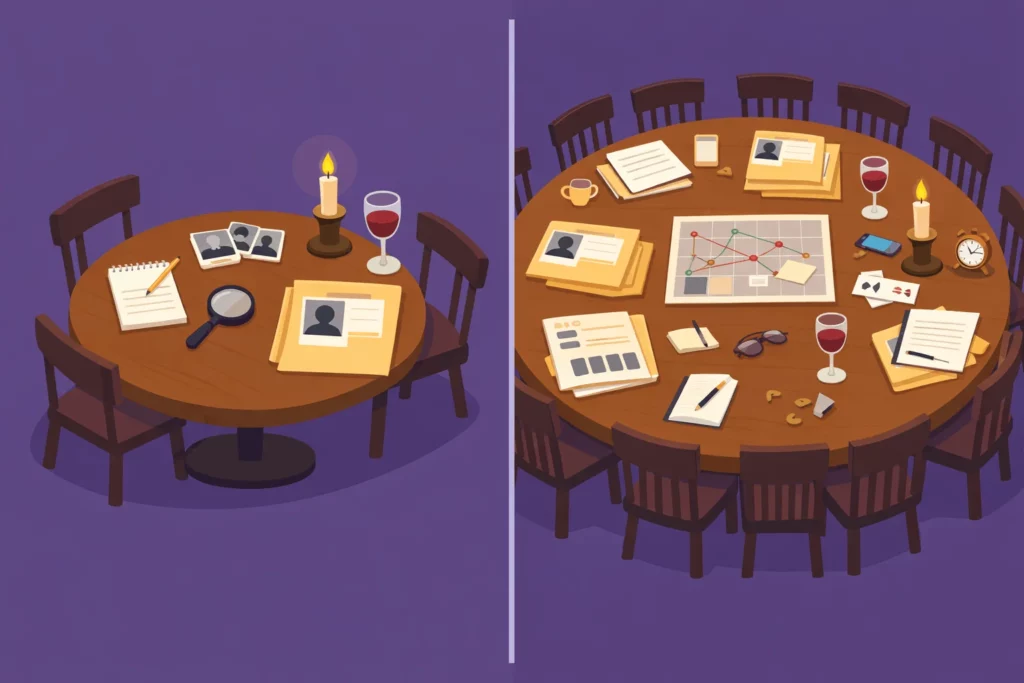
Even the most brilliantly designed mystery game can fall apart if it doesn’t suit the individual or group playing it.
Player count isn’t just a number on the box. It shapes the entire experience. Energy levels, pacing, character depth and social interaction all shift depending on how many people are involved. And if you’re playing by yourself, there are going to be certain types of murder mystery games that you just can’t play.
Before choosing a murder mystery game, start with three practical questions:
- How many confirmed players will you have?
- Are they comfortable performing in character, or do they prefer structured problem-solving?
- Do you want high-energy interaction or focused deduction?
Match the advertised player range carefully
While some murder mystery games don’t require or recommend a specific number of players, many do. For example, most murder mystery party games list a minimum and maximum number of players.
Don’t treat this range casually.
If you have six players and the game is designed for 8–12, someone may need to play multiple roles or important plot threads may be removed. That can weaken both immersion and logic.
On the other hand, squeezing twelve players into a game designed for six usually leads to disengagement. Some guests will feel peripheral.
If possible, choose a game where your expected player count sits comfortably in the middle of the suggested range, not at the extreme edge, as this will give everyone the best experience.
Check whether roles are essential or flexible
Some murder mystery games position players as detectives who examine clues to solve the case. Others involve the players in something akin to a play. In those kinds of games, players take on specific roles.
Some role-playing mystery games are tightly scripted. Each character carries unique information that drives the plot forward. These games work best when the full cast is present.
Others are modular, meaning all or some of the roles can be added or removed without breaking the story. If your guest list may fluctuate, flexibility matters, so this might be a better option for your situation.
Look for product descriptions that clearly explain whether or not the game is adopts a role-playing style, and if so, whether the roles are fixed or adaptable.
Consider your group’s personality
An outgoing group often enjoys dramatic accusations, secret alliances and theatrical moments. In that case, choose a game with strong character backstories and plenty of interaction prompts.
A quieter or more analytical group may prefer clearly structured rounds and logical clue progression over improvisation.
The best murder mystery game for your situation isn’t just about numbers. It’s also about social comfort.
When player count, personality and structure align, the evening flows naturally. Conversations feel purposeful. Suspicion builds organically. No one feels sidelined.
That alignment is what turns a game into an experience.
What to look for in murder mystery games for small groups (4–6 players)
Smaller groups create a more intimate, focused experience. Each player carries more narrative weight, and character backstories tend to be richer and more detailed.
In this setting, logical structure becomes even more important. With fewer suspects, inconsistencies are easier to spot. Clues must be carefully balanced to avoid making the solution too obvious or impossibly vague.
Small-group mystery games work beautifully for family game nights, close friends or puzzle enthusiasts who enjoy deeper deduction.
What to look for in murder mystery games for medium-sized groups (7–10 players)
This is the sweet spot for many murder mystery party games.
There’s enough variety for layered suspicion, shifting alliances and dynamic conversations. Characters can have secrets that intersect in interesting ways without overwhelming the players.
A well-designed game for this group size maintains clarity while allowing room for dramatic interaction. It should encourage participation without forcing anyone into uncomfortable levels of performance.
What to look for in murder mystery games for large groups (10+ players)
Large murder mystery parties bring energy, laughter and chaos in equal measure. But they also introduce design challenges.
If too many characters feel irrelevant, engagement drops. If instructions aren’t crystal clear, confusion spreads quickly, especially if many of the players are new to murder mystery games. Strong structure becomes essential.
For larger groups, look for games that clearly define roles, distribute information evenly, and provide simple hosting guidance. The goal is controlled intrigue, not logistical mayhem.
Theme and immersion: Does the story pull you in?
A mystery isn’t just a puzzle. It’s got to be a puzzle carefully matched to a well-constructed world.
The setting, the characters, the secrets and the tone all work together to create immersion. Without that, even the most logically sound murder mystery game can feel flat.
Strong themes give players something to step into. E.g.:
- A glamorous 1920s soirée filled with scandal and champagne
- A haunted manor where long-buried resentments resurface
- A Hollywood awards night where ambition turns deadly
- A high school reunion with unfinished business
The theme should feel cohesive. Character names, motives, and clues (and props, if there are any) should all reinforce the same narrative world. When elements feel random or disconnected, immersion breaks.
Well-designed murder mystery games use theme to support the logic of the case. Motives grow naturally from the setting. Clues make sense within the world. The solution feels like an inevitable outcome of the story rather than an external twist imposed on it.
Character depth also plays a crucial role. The best mystery games provide players with:
- Clear motivations
- Personal secrets
- Meaningful relationships with other suspects
- Distinct personalities
Flat characters can weaken immersion in role-playing mystery games. When suspects feel interchangeable or underdeveloped, conversations stay shallow and accusations lack tension.
In deductive case-file style games, the equivalent problem is thin narrative context. If the victim, suspects and circumstances aren’t clearly defined, the investigation can feel mechanical rather than compelling.
Layered characterisation — whether expressed through live role-play or written evidence files — gives the mystery weight. Motives feel believable. Relationships feel complex. The stakes feel real.
That depth is what transforms a series of clues into a story worth solving.
Immersion doesn’t require elaborate costumes or expensive decorations. It requires consistency and thoughtful storytelling.
When the theme is strong, players stop ‘playing a game’ and start behaving like suspects, witnesses, and detectives. Conversations feel organic. Accusations feel charged. The final reveal carries emotional weight.
A great murder mystery game doesn’t just hide the truth. It makes you care about uncovering it.
Difficulty level and clue design: Is it challenging or just confusing?
When people search for the best murder mystery game, they often ask about difficulty.
But difficulty can mean very different things.
Some games are labelled ‘hard’ because they require complex, layered deduction. Others feel difficult simply because the instructions are unclear or the clues are poorly structured.
Those are not the same thing.

A well-designed mystery game is challenging in a fair and deliberate way. It asks players to observe carefully, connect information and test assumptions. It doesn’t overwhelm them with irrelevant details or force them to guess.
There are generally three broad levels to consider.
Beginner-friendly murder mystery games
These are ideal for first-time hosts or solo players, casual party settings, or family groups.
Clues tend to be straightforward. Motives are clear. The structure guides players gently toward key revelations. The experience focuses more on interaction and fun than on intricate deduction.
A beginner-friendly murder mystery game should feel accessible without being simplistic.
Intermediate murder mystery games
This is where many experienced hosts prefer to sit, and it’s the next logical progression for solo players and families who’ve correctly solved several beginner-level mystery games and are ready for more of a challenge.
Clues may be layered. Suspects may have overlapping secrets. Red herrings, meaning misleading but plausible clues, are used carefully to deepen intrigue without breaking fairness.
Players need to think, but the solution remains logically reachable. These games also don’t tend to take as long to solve as the more advanced games.
Advanced or difficult murder mystery games
These are designed for confident puzzle-solvers who enjoy complex reasoning and are prepared to spend several hours solving a crime.
Information may be distributed unevenly. Players may need to analyse timelines, contradictions or subtle behavioural cues. Multiple suspects may appear equally plausible until late in the game.
In a strong advanced mystery, the difficulty comes from intellectual depth, not confusion.
What to watch for
When choosing a murder mystery game, look for clear signs that the difficulty comes from structured reasoning, not confusion.
Read product descriptions, sample materials, and reviews carefully and ask yourself:
- Is the challenge based on logical deduction, or does it rely on hidden information?
- Are clues or evidence presented progressively, or do players need to piece together scattered, unclear details?
- Do reviews mention a satisfying ‘aha’ moment when the solution is revealed?
In role-playing mystery games, this often comes down to how information is revealed through rounds and character interactions.
In case-file style games, it depends on how evidence is organised and whether it supports a clear line of reasoning.
The best murder mystery games respect the intelligence of their audience while guiding them through a coherent structure. They stretch your thinking without snapping it.
Challenging should mean satisfying. Not exhausting.
Format matters: Printable, boxed, or online?
When choosing the best murder mystery game, format plays a bigger role than many people realise.
The structure of the mystery may be brilliant, but the delivery format affects cost, convenience, preparation time, and overall experience.
Each option has strengths. The key is matching the format to your situation.

Printable and downloadable mystery games
Printable or downloadable mystery games are increasingly popular, not just for party hosts but also for solo players and small groups looking for a more focused investigative experience.
The biggest advantage is immediacy. You can purchase, download, and start preparing straight away, without waiting for shipping. This makes them ideal for last-minute plans, regional areas, or budget-conscious buyers. You can even play some of them via Zoom.
There are two main types to be aware of.
Role-playing mystery games are designed for groups. Players take on characters, interact with each other and uncover the story through structured rounds or prompts.
Case-file style mystery games are more analytical. You work through evidence, documents and clues at your own pace, either solo or with a small group. These are closer to detective investigations than party experiences.
Both types of printable/downloadable games are often more affordable than boxed murder mystery game kits because there are no manufacturing or freight costs built into the price.
However, they do require some preparation, which can be time consuming. For example, you may need to print and compile character sheets, evidence files, or invitations. And the quality and organisation of these materials can influence the overall experience.
A well-designed printable mystery game keeps instructions clear, materials structured and setup manageable, whether you’re hosting a group or solving the case yourself.
Boxed murder mystery games and kits
Boxed kits appeal to those who enjoy a tactile, ready-to-use experience.
They often include printed character booklets, physical props, or themed materials. And as some of these materials can’t be printed with a traditional printer, this means they often contain materials that you miss out on if you stick with a printable game. For party settings, having a variety of physical resources on hand can enhance immersion and reduce preparation time.
Most boxed murder mystery game kits are designed for group play, particularly social, role-based experiences. However, there are plenty of boxed case-file type games that can be played solo.
The trade-off with any physical games is cost and delivery time. Boxed games tend to be more expensive and may not suit last-minute planning, especially if shipping is required. If you’re lucky enough to have boxed murder mystery games in your local shops, you’ll avoid shipping hassles and wait times, however, there may be a limited range to choose from.
Quality also varies significantly. A higher price doesn’t automatically mean better structure, higher quality resources, stronger clue design, or a more satisfying solution.
Online or virtual murder mystery games
Online mystery experiences offer flexibility, particularly when players are in different locations.
They allow groups to participate remotely, making them popular for team-building events, long-distance friends, or hybrid gatherings.
Some online formats replicate role-playing party games, while others lean toward guided investigations or interactive digital case files.
However, digital delivery changes the social dynamic. Energy, pacing and interaction can feel different compared to in-person play. Clear facilitation and structure become even more important.
Choosing the right format
When choosing a format, focus on how you actually want to experience the mystery.
Ask yourself:
- Do you want a social, interactive experience or a focused investigative challenge?
- How much preparation time do you realistically have
- Are players in the same location or joining remotely
- Do you prefer physical materials or digital convenience?
- What is your budget per player?
The best murder mystery game isn’t just about story quality. It’s about how the experience fits your situation.
A strong design, delivered in the right format, creates a smooth experience from purchase to final reveal.
Setup time and hosting effort: How much work is involved?
One of the most overlooked factors when choosing a murder mystery game is preparation time.
Some games are genuinely plug-and-play. Others require careful planning, printing, organising materials, and coordinating guests well in advance (if you’re hosting a party).
Neither approach is wrong. But mismatched expectations can quickly turn excitement into stress.
Before purchasing any kind of murder mystery game, but especially party games and printable games, consider what the set up and, where relevant, the host role actually involves.
Preparation requirements
Ask yourself:
- Does the game require extensive printing or cutting
- Are invitations and character assignments straightforward?
- Are instructions clearly laid out for the host, or do you need to decipher them?
- For digital games, can the materials be printed or does everyone playing need a device?
A well-designed game respects the players’ and the host’s time. Materials should be logically organised. Instructions should follow a clear sequence. The host and/or players should feel guided, not burdened.
Costume and theme expectations
Some murder mystery games encourage elaborate costumes and themed decorations. Others work perfectly well with minimal preparation.
If your group loves theatrical flair, this can enhance immersion. If not, overly complex expectations may discourage participation.
The best games make costumes optional rather than essential.
Host involvement during gameplay
In some formats, the host plays a character alongside everyone else. In others, the host acts as facilitator, guiding rounds and revealing information.
Think about which role you prefer. Do you want to solve the case yourself? Or would you rather manage the flow and watch the drama unfold?
Clear guidance on hosting responsibilities is a sign of strong game design.
Time commitment
How long does the game run?
Is it structured in defined rounds?
Does it allow flexibility if conversations run longer than expected?
A thoughtfully designed mystery game accounts for real-world dynamics. It provides structure without rigidity.
When setup requirements align with your available time and energy, the experience feels enjoyable rather than overwhelming.
Hosting and/or setting up a murder mystery game should feel exciting — not like project management.
Replayability and value for money: Is it worth the investment?
Price alone doesn’t determine value.
A higher-priced murder mystery game isn’t automatically better. A lower-priced printable game isn’t automatically inferior. What matters is what you receive in return for your investment.
Start by considering cost per player.
A $60 boxed murder mystery game for eight players works out differently than a $35 downloadable mystery for ten or a $25 boxed mystery for one. Breaking the cost down this way gives you a clearer picture of value.
Next, look at replayability.
- Can characters be swapped so different players can experience new roles?
- Does the structure allow the game to be reused with another group?
- Are materials durable or easily reprinted if needed?
Some murder mystery party games are designed as one-time experiences. Others are built with flexibility in mind. Neither is wrong, but it’s important to know what you’re purchasing. A $100 game you can play as many times as you like is going to be better value than a $50 game you can only play once. (Pro tip: If you’ve got a group of friends who all like playing murder mystery games either together or individually, you could pool together funds for several games and play together or each take turns at solving them, thus lowering the cost for each person.)
Also consider hidden costs.
- Will you need to print large volumes of colour materials?
- Are props required?
- Does the format require shipping fees or international delivery costs?
Value isn’t just about price. It’s about clarity, fairness and the overall experience delivered.
A well-designed mystery game creates memorable moments, lively conversations and a satisfying final reveal. When players leave feeling impressed and engaged, the investment feels justified.
The best murder mystery games deliver more than an evening’s entertainment.
They create stories your guests will talk about long after the case is closed.
Age suitability: Adults, families or kids?
Not every murder mystery game suits every audience.
Tone, complexity and subject matter vary widely across the market. Choosing the right fit for your group ensures the experience feels engaging rather than uncomfortable or confusing.
Murder mystery games for adults
Many traditional murder mystery games are written with adult themes in mind. Motives may involve romance, betrayal, ambition, or financial intrigue. Dialogue can be layered with sarcasm or subtle humour. And plots may include subject matter that’s unsuitable for younger children, such as rape.
For adult groups, complexity can also be higher. Clues may require careful interpretation. And social dynamics often play a central role in how suspicion unfolds in group games.
The best murder mystery games for adults balance challenge with clarity. They provide depth without becoming inaccessible.
Family-friendly mystery games
For mixed-age groups, tone matters.
A family-friendly mystery game keeps content appropriate while maintaining strong structure. Motives may revolve around misunderstandings, friendly rivalries, or light-hearted conflicts rather than darker themes. And language may be simpler.
Clue design should remain logical and solvable, but accessible to younger participants.
A good family mystery respects children’s intelligence without overwhelming them.
Mystery games for kids and classrooms
When designed thoughtfully, mystery games can be powerful learning tools. They encourage critical thinking, deduction and collaborative problem-solving. Players analyse evidence, test theories and practise structured reasoning.
For classrooms, younger groups, and kids playing solo, the best mystery games provide:
- Clear instructions
- Age-appropriate language and themes
- Guided progression through clues
- A fair and satisfying resolution
The goal isn’t to simplify the mystery. It’s to make the logic approachable.
Choosing the right age level ensures that everyone feels included and capable of participating fully in the investigation.
A great mystery challenges the mind. The right mystery challenges it at the right level.
How to choose the best murder mystery game for your situation
By now, one thing should be clear. There isn’t a single ‘best’ murder mystery game for everyone.
There is only the best one for your specific group, occasion and expectations.
To make the right choice, walk through these questions.
Hosting a birthday party or celebration?
Prioritise energy and interaction.
Choose a murder mystery party game with clear character roles, strong thematic flair and manageable setup. Medium-sized groups often create the best balance of drama and structure.
Look for a game that encourages conversation, interaction and playful suspicion rather than silent puzzle-solving.
Planning a team-building event?
Focus on collaboration and structured deduction.
Select a game with layered clues, logical fairness and opportunities for shared reasoning. Clear instructions and defined rounds help maintain momentum.
If your group prefers analysis over acting, consider a more structured or case-file style mystery rather than a heavily role-played format.
Organising a family game night?
Keep tone and accessibility in mind.
A family-friendly mystery game should balance challenge with clarity. Motives should feel engaging without becoming uncomfortable. Clue progression should guide younger players without oversimplifying the case.
Look for games that allow both discussion and deduction so everyone can participate.
Running a classroom activity?
Structure is everything.
Choose a mystery game with explicit instructions, age-appropriate language and a clearly solvable conclusion. Educational mystery games work best when deduction is transparent and evidence is well organised.
Case-file style mystery games are often particularly effective in classrooms, as they encourage analysis, reasoning and collaborative problem-solving. However, if you’re looking for a role-playing game, make sure you look for games that have sufficient roles for the number of students in your class. This could be challenging if you have a large class size.
Either way, the goal is not just entertainment, but developing thinking skills.
Seeking a serious puzzle challenge?
Lean into complexity.
Look for a difficult mystery game with layered motives, intersecting clues and subtle connections between pieces of evidence.
Case-file and investigative-style games often suit this best, as they allow for deeper analysis and less reliance on performance.
Make sure the difficulty comes from intellectual depth, not withheld information.
Even advanced games should remain fair.
Want to solve a mystery solo?
Not every mystery game needs a group.
If you prefer to work through a case at your own pace, look for case-file or investigative mystery games designed for solo play.
These typically include evidence packs, documents, timelines and clues that you analyse independently. There’s no need for role-playing or hosting, just careful observation and logical thinking.
When choosing a solo mystery game, check:
- Is it explicitly designed for one player or small groups?
- Are the materials clearly organised and easy to follow?
- Does the structure guide you without giving away the solution?
A strong solo mystery should feel immersive without being overwhelming. It should challenge your reasoning while giving you everything you need to solve the case.
Sometimes, the best detective work happens alone.
The real test of a great mystery game
In the end, the best murder mystery games share a common thread.
They’re clever without being cruel. Structured without being rigid. Immersive without becoming chaotic.
They give players the information they need. They reward attention. They build tension with purpose.
And when the solution is revealed, the reaction isn’t confusion. It’s recognition. The clues were there. The logic holds. The story makes sense.
That’s the difference between a forgettable solo or party activity and a genuinely satisfying mystery experience.
The best mystery games don’t trick you. They challenge you — and let you rise to the occasion.