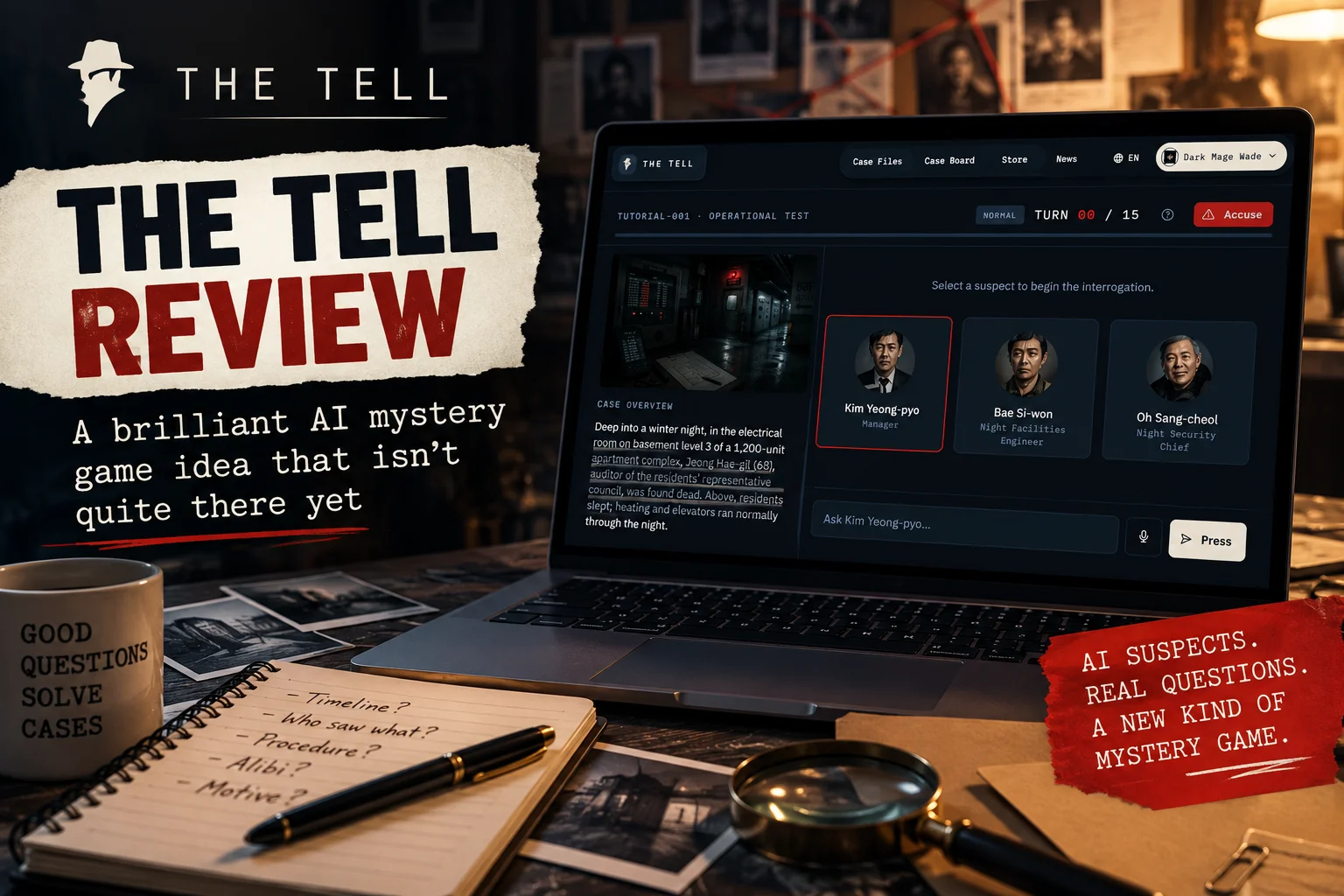
Most detective games let you interrogate suspects, provided you stick to the questions somebody else has written for you.
‘Where were you last night?’ ‘Did you know the victim?’ ‘Why did you argue with them?’
You click whichever option looks promising and wait for the next clue. Sometimes the writing is excellent, but the dialogue menu has already done some of the detective work. If the game offers a question about an argument, you can be reasonably confident that argument matters.
The Tell takes away the menu.
Instead, it gives you a blank text box and invites you to conduct the interrogation yourself.
You can ask about alibis, workplace procedures, suspicious behaviour or an apparently insignificant detail that's bothering you. You can follow up on something a suspect said, challenge their account or pursue a theory the game's designers might never have anticipated.
As someone who loves a good mystery and has a background in forensic science, I found that prospect enormously appealing. Finally, a detective game where I could decide what questions needed asking.
I completed The Tell's tutorial and two full cases, First Report and Where the Wind Blows. I solved both full cases within their 15-turn limits, yet finished them feeling that I'd been denied some of the information I needed to investigate properly.
That was an odd combination: the satisfaction of getting the answer right, without quite the satisfaction of working out what happened.
The Tell has one of the most promising ideas I've encountered in an online mystery game. Whether it delivers on that promise is a more complicated question.
The Tell at a glance
Best for: Solo mystery fans who enjoy questioning suspects and working through short investigations
Format: Browser-based AI detective game
Typical play time: Approximately 10–20 minutes per case
Core mechanic: Type or speak your own questions to AI-generated suspects
Cases tested: Tutorial, First Report and Where the Wind Blows
My results: First Report in 10 turns; Where the Wind Blows in 14
Biggest strength: The freedom to conduct your own interrogations
Biggest weakness: Too much of the limited investigation can be spent establishing basic facts
Verdict: An intriguing, enjoyable experiment in AI-powered detective gaming that needs stronger case design and a little more polish
What is The Tell?
The Tell is an online mystery game built around short investigations and AI-generated conversations.
Each case introduces a scenario, several suspects and evidence you can examine. Your job is to work out what happened, who was responsible and which explanation best fits the information you uncover.
The unusual part is how you gather that information.
Rather than choosing from a list of dialogue options, you type or speak your own questions. The suspects respond using generative AI, with different personalities and varying degrees of willingness to cooperate.
The cases I played allowed 15 turns before I had to make an accusation. Submitting an interrogation prompt uses a turn, and examining evidence can consume turns too. How efficiently you solve the mystery contributes to the game's ranking system.
The Tell is designed for relatively quick sessions. Its investigations are presented as experiences lasting around 10–20 minutes, and because the game runs in a browser, there's nothing to install.
The premium Season 1 collection is organised into five arcs of five cases each. The game also offers introductory and other free-play opportunities, with additional cases available through its access and purchasing system.
It's an appealing format for anyone who enjoys detective games but doesn't always have an entire evening to devote to one.
The best part is being able to interrogate suspects yourself
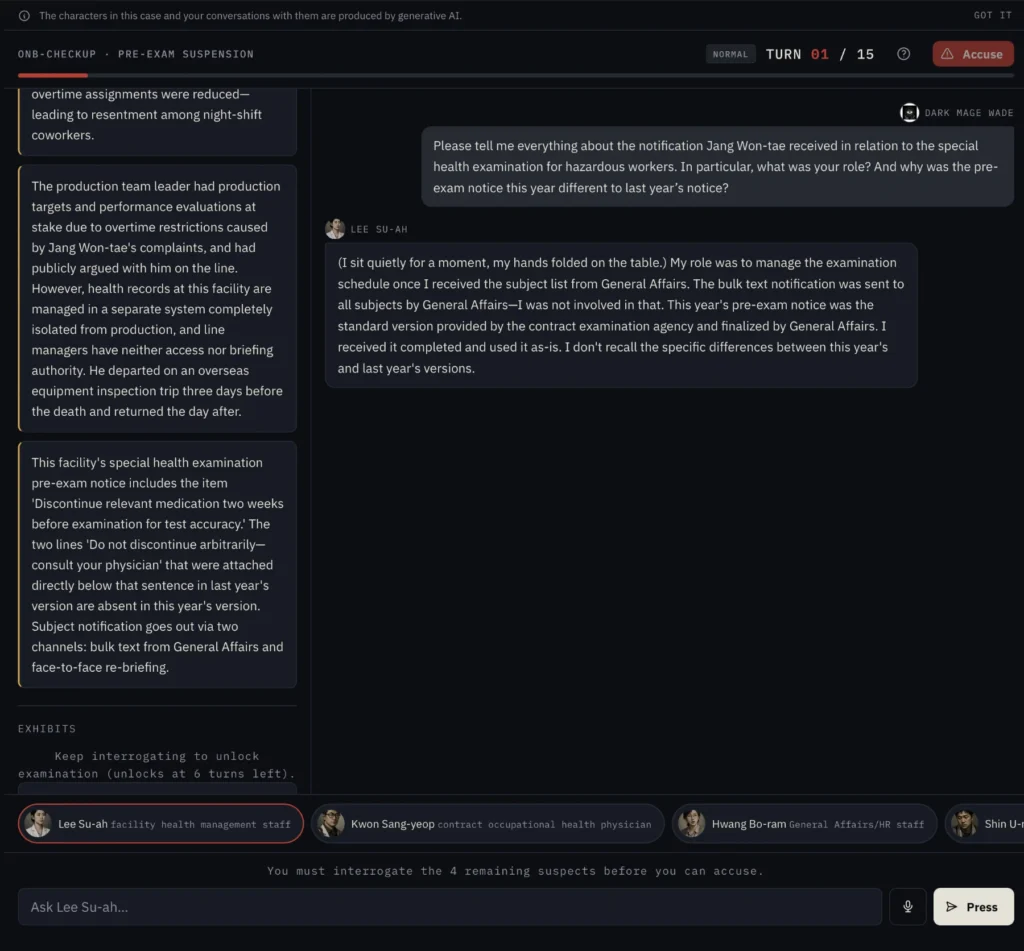
The freedom to ask your own questions is easily The Tell's greatest strength, and it changes the experience more than you might expect.
Consider a conventional detective game in which you're offered these questions:
- Where were you at midnight?
- Did you know the victim?
- Who else was present?
- Why did you argue with them?
Even before you've spoken to the suspect, you've learned that midnight, another person's presence and an argument are potentially relevant.
In The Tell, nobody hands you that shortlist. You have to decide whether an alibi matters, which period of time to investigate and what you need to know about the relationships between suspects.
That creates a much stronger sense of agency. You're forming questions based on your understanding of the case rather than trying to identify the most promising option in a dialogue tree.
The suspects also have distinct personalities. Some are guarded, some more forthcoming, and others become defensive when you challenge them.
One character I questioned repeatedly pushed back against my approach, effectively asking whether I was trying to establish what happened or simply looking for someone to blame.
I liked that response. It made the exchange feel less like querying a database and more like dealing with someone who had their own perspective on the investigation.
There's real potential here. A suspect who responds to your particular question, rather than selecting a predetermined answer, can make a mystery feel considerably more alive.
Unfortunately, the freedom to ask anything is only useful when the underlying case contains enough information to answer the questions that matter.
Not every case is a conventional whodunnit
One of The Tell's more interesting choices is that it doesn't restrict itself to deliberate murder.
Some investigations involve accidents, negligence, procedural failures or chains of events in which someone's actions contributed to a death without any intention to kill.
I appreciated that variety. There's only so many times you can investigate a poisoned dinner guest before you start wondering whether the entire mystery-game population should stop accepting invitations.
Cases involving negligence or accidental deaths demand a slightly different kind of reasoning. Rather than focusing exclusively on motive, means and opportunity, you may need to establish how a system operates and where responsibility lies.
Who was supposed to act? What information did they have? Did they follow the correct procedure? Could a different decision have prevented the outcome?
Those can be excellent foundations for a mystery, particularly when several people contributed to a chain of events.
They do, however, require the player to understand that chain well enough to investigate it.
And this is where I began running into trouble.
I spent too many turns trying to understand the situation
In one industrial investigation, I needed to reconstruct how an emergency message travelled through a workplace.
One person sent information. Another recorded it. Someone else occupied an intermediate role. Eventually, an announcement was made.
The difficulty was that I didn't initially understand what each person was responsible for, how the communication process normally worked or which parts of it might have gone wrong.
Before I could investigate whether anyone had made a consequential mistake, I had to establish the basic procedure.
So I started asking questions about people's jobs and responsibilities.
Then I needed to ask about the sequence of events.
Then I needed to clarify who had communicated with whom.
All perfectly reasonable questions. But every one of them consumed part of the limited investigation.
I wasn't yet testing a theory about what had happened. I was trying to understand the situation well enough to develop one.
Other cases presented similar difficulties with basic timeline information. I wanted to know who found the victim, when they were discovered and approximately when they had died.
Those aren't unusually sophisticated questions. They're fundamental to establishing opportunity.
If someone was near a particular location, for example, that fact is only useful if you can place them there at a relevant time.
My forensic-science background probably makes me especially attentive to timelines, access and opportunity. But you don't need forensic training to recognise that a suspect's movements are difficult to assess without knowing when the event occurred.
In some of my investigations, I couldn't obtain the information I was looking for.
A mystery should certainly leave you uncertain about what happened. That's the point. But there's a difference between evidence that supports several plausible explanations and basic contextual information that you can't seem to establish.
The former gives you a puzzle to solve. The latter makes it difficult to know what puzzle you're solving.
I don't think The Tell needs to provide every relevant fact at the beginning. That would defeat the purpose of investigating. It does, however, need to give players enough context to start asking meaningful questions.
A clearer initial briefing about workplace roles, established procedures and known timelines would have made some of these cases considerably more satisfying without revealing their solutions.
Solving a case isn't quite the same as deducing it
Despite those frustrations, I solved both full cases I played.
First Report took me 10 of the available 15 turns. Where the Wind Blows took 14.
That might suggest the difficulty was well balanced. I had enough information to identify the correct answer before running out of questions, after all.
But getting the answer right didn't always mean I felt confident about the reasoning that led me there.
The best mysteries reward you with a moment when the clues fall into place. You can explain why one interpretation works, why the alternatives don't and how the details you've uncovered support the conclusion.
In The Tell, I sometimes reached the point of thinking one explanation was more likely than the others without feeling I'd established the complete sequence of events.
I could make the correct accusation. I couldn't necessarily reconstruct everything that had happened.
That's a meaningful distinction in a detective game.
It also points to a challenge for anyone designing mysteries around generative AI.
A conversational system may be capable of answering an enormous variety of questions, but the mystery underneath it still needs to be coherent. The timeline must make sense. Characters need consistent knowledge. Evidence must support the solution, and the information required to reach it must be available through reasonable investigation.
Giving players more freedom to ask questions doesn't reduce the importance of those foundations. If anything, it exposes weaknesses that a carefully controlled dialogue tree might conceal.
The Tell's interrogation system is clever enough to make me want to investigate thoroughly. Its case design doesn't always let me.
The 15-turn limit creates tension, but rewards prompt optimisation
I understand why The Tell limits the number of turns.
Without a constraint, you could keep questioning every suspect until you'd exhausted virtually every possibility. A limit makes you prioritise, and the ranking system gives you a reason to investigate efficiently.
Fifteen turns is enough to create genuine pressure without making a case feel like an enormous commitment.
But the limit also encourages a behaviour I doubt the designers intended: trying to squeeze as many questions as possible into each prompt.
At one point, I asked:
‘Please describe your standard operating procedure in detail. Then tell me everything you know about what happened on the night of the incident.’
That's two substantial lines of questioning packaged into a single message.
The game allowed it, and it was an efficient use of a turn. It also felt less like interviewing a suspect and more like optimising a prompt for an AI chatbot.
In a natural conversation, I'd probably ask someone to explain their usual procedure first. Their answer might reveal something worth following up before I moved on to what happened on the night in question.
The Tell's turn limit discourages that approach. Asking the questions separately costs more, even when the first answer might reasonably change the second question.
This creates a strange tension between the game's two defining mechanics. Free-form AI conversations invite you to question suspects naturally, while the turn economy rewards you for bundling your questions into increasingly elaborate prompts.
I wouldn't remove the limit. The pressure is useful, and solving a case efficiently should feel rewarding.
I'd rather see the starting information improved so players can spend their turns investigating the mystery instead of extracting the basic briefing they needed before the interrogation began.
Late evidence doesn't always arrive at a useful time
The timing of evidence introduces another complication.
During my playthroughs, some information only became available when I had six or fewer turns remaining.
There's a good idea behind that mechanic. Investigations develop over time. New evidence can challenge an early assumption, reveal a contradiction or make a previously unimportant detail suddenly relevant.
But with only 15 turns available, the timing of a revelation matters.
Suppose you spend several questions establishing a suspect's movements, only to receive evidence near the end that changes how you interpret their account. You may now want to question them again, but you've already used much of your interrogation budget.
That's not automatically unfair. Managing incomplete information is part of detective work.
The difficulty comes when the evidence feels arbitrarily withheld rather than discovered through the investigation. If it would have materially changed your earlier questions, you can end up feeling that some of those turns were wasted through no fault of your own.
I'd like to see The Tell make the arrival of late evidence feel more deliberate. Perhaps the game could flag that certain results are pending, introduce new exhibits as developments in the investigation or allow a limited number of follow-up questions after a significant discovery.
Any of those approaches could preserve the challenge while giving players a fairer opportunity to act on what they've learned.
The suspects have personality, but the conversations aren't always natural
The Tell's characters are more interesting than a collection of interchangeable information sources.
Their profiles establish different personalities, and those differences can influence their responses. Some answer directly. Others are evasive, defensive or reluctant to volunteer information.
It's a promising use of generative AI because the character's manner becomes part of the experience, not merely a decorative detail in a biography.
Occasionally, though, the conversational illusion breaks.
Remember the defensive suspect who challenged my motives?
In a real interview, a question like that would invite a response. I might reassure them, explain my reasoning or push back.
Instead, the character asked the rhetorical question and continued answering mine without waiting.
It was a small moment, but it reminded me that I wasn't having an ordinary conversation. I was interacting with a system designed to produce a response to each submitted prompt.
Making the suspect wait for my answer wouldn't necessarily improve things under the current rules, either. I'd have to spend another turn responding to a conversational challenge rather than investigating the case.
That's a difficult design problem, and I don't have a perfect solution.
The Tell wants its characters to behave like people while its turn system treats each exchange as a limited investigative resource. Those goals can work together, but the game hasn't entirely reconciled them yet.
The English version could use another editing pass
I also encountered some awkward phrasing in the English-language version.
I don't know how The Tell's dialogue and other text are produced or localised, so I can't say what causes the problem. I can only judge what appeared on screen.
Some sentences felt unnatural or less clear than they should have been.
In many games, that would be a relatively minor complaint. Mystery games are less forgiving because wording can carry clues.
If a suspect phrases something strangely, I want to know whether they're being evasive, concealing information or revealing something important. I don't want to spend time wondering whether the sentence itself is simply awkward.
That becomes especially frustrating when the case involves unfamiliar workplace procedures or technical responsibilities. Precise language is essential if players are expected to identify discrepancies in what people say.
A careful English-language editing pass would make the investigations easier to follow without making the mysteries any less challenging.
An evidence bug still affects the turn economy
I encountered a technical problem during my original testing in September 2026 and checked it again when I revisited The Tell in October.
The behaviour had changed, but the problem hadn't been fully resolved.
During my initial playthrough, examining one piece of evidence could cause the game to display the same response when I tried to inspect evidence associated with other suspects. Refreshing the browser corrected the display.
When I returned in October, the interface behaved differently. After examining one piece of evidence, I couldn't access the others until I refreshed the browser.
Once I refreshed, however, the remaining evidence became available without deducting the turns that would ordinarily be required to examine it.
That means the interface problem has improved in one respect, but refreshing still appears to bypass part of the intended evidence cost.
It's particularly unfortunate in a game where the number of turns used contributes to player rankings. If evidence can sometimes be examined without the intended deduction, players may not be completing their investigations under comparable conditions.
I encountered this behaviour during my own testing, so I can't say how widely it affects other players or whether it occurs in every case.
Still, it's a bug worth fixing. When the entire challenge revolves around managing limited investigative opportunities, the rules governing those opportunities need to work consistently.
Why I'd still recommend trying The Tell
For all my criticisms, I enjoyed enough of The Tell to want to play more.
The short cases are convenient, the browser-based format removes most of the usual setup, and the ability to question suspects in your own words gives the investigations a refreshing sense of freedom.
I also appreciate the variety of scenarios. Cases involving negligence, accidents and procedural failures can be just as intriguing as deliberate murders, particularly when they require you to reconstruct a sequence of decisions.
The Tell offers a free introductory case, with other free-play opportunities and premium investigations available. Paid collections have been offered with permanent access rather than an ongoing subscription, although it's worth checking the current arrangements before purchasing.
For someone curious about AI detective games, that makes it reasonably easy to try the concept before committing to a larger collection.
What keeps me interested, though, isn't the pricing or the convenience.
It's the possibility of asking a suspect a question I thought of myself and receiving an answer that helps me test my own theory.
That feels different from following a predetermined trail of dialogue options.
When The Tell gets it right, it's a glimpse of something I want more mystery games to attempt.
What The Tell reveals about the future of AI mystery games
The Tell demonstrates why conversational AI could be such an interesting addition to detective games.
Traditional mystery games are constrained by the questions their designers anticipate. Even an elaborate branching dialogue system can only offer the paths somebody has written.
Generative AI makes it possible to respond to questions outside those predetermined paths. In theory, that allows players to approach a mystery from different angles and investigate according to their own reasoning.
But that freedom introduces a demanding new standard for the underlying case design.
If a player can ask almost anything, the fictional world needs to withstand questions the designer may never have considered.
That means establishing a coherent sequence of events, deciding what each character knows, ensuring the evidence is consistent and making the solution logically accessible.
The AI shouldn't have to invent missing facts simply because a player asks an unexpected question. Ideally, it should help the player explore an already coherent mystery.
That's the distinction I think will separate genuinely excellent AI detective games from interesting demonstrations of conversational technology.
The Tell has already shown that free-form interrogation can be enjoyable. The next challenge is ensuring the mysteries are robust enough to reward that freedom.
Is The Tell worth playing?
Yes, particularly if you're interested in detective games and curious about what generative AI can add to them.
The Tell is quick to get into, offers unusual investigative freedom and has enough variety to make its short cases appealing.
Its biggest weakness is the gap between what its interrogation system invites you to do and what the underlying mysteries consistently support.
I wanted to ask thoughtful questions, test hypotheses and reconstruct events. Too often, I found myself spending valuable turns establishing basic context, working around the timing of evidence or trying to make my questions as information-dense as possible.
The occasional awkward English and the evidence bug I encountered add to the rough edges, although neither undermines the game's central idea as much as the case-design issues.
I'd recommend trying the free introductory content before purchasing additional cases. You'll quickly discover whether the freedom to interrogate AI suspects outweighs the frustrations I've described.
For me, it does, although I hope future improvements make the experience more satisfying.
The Tell isn't yet the AI detective game I want it to become. But after playing it, what I wanted wasn't a different kind of game.
I wanted a better version of this one.
What is The Tell?
The Tell is a browser-based AI mystery game where you investigate short cases by questioning suspects and examining evidence. Unlike traditional detective games with fixed dialogue choices, it lets you type or speak your own questions and receive AI-generated responses.
Can you really ask suspects anything in The Tell?
You can formulate your own questions rather than selecting from a predetermined list. That gives you considerable freedom to investigate different theories and follow up on suspects' statements.
However, the usefulness of the answers depends on the information available within the case and what the characters are able to tell you. And there’s a limit to the length of each question.
How long does a case take?
The Tell presents its cases as approximately 10–20-minute investigations. The full cases I played allowed 15 turns before I had to make an accusation.
Is The Tell free?
The Tell offers free introductory play and other free-access opportunities, alongside premium cases and collections.
Paid content has been offered as permanent-access purchases rather than subscriptions. Check the game's current access rules and pricing before purchasing, as these may change.
Is The Tell a murder mystery game?
Some cases involve deliberate acts and suspicious deaths, but others explore accidents, negligence and procedural failures. The objective isn't always to identify an intentional murderer. Sometimes you need to determine who was responsible for a particular outcome.
Does The Tell use AI?
Yes. The Tell states that its characters and the conversations you have with them are generated using AI. This allows players to ask questions in their own words rather than relying on a fixed dialogue tree.
Is The Tell difficult?
I solved First Report in 10 turns and Where the Wind Blows in 14, within the 15-turn limit for each.
I didn't find the cases impossible to solve, but I sometimes struggled to obtain basic contextual information needed to investigate thoroughly. That made parts of the experience frustrating for reasons unrelated to the difficulty of the actual mystery.
Is The Tell worth playing?
I think it's worth trying, especially if you enjoy detective games and want to experiment with free-form AI interrogation.
The central mechanic is genuinely interesting, the cases are short and the scenarios offer welcome variety. The game still needs improvements to its starting information, evidence timing, English-language clarity and technical reliability, but there's a lot of potential in the format.
Review note: Based on my own playthroughs of The Tell's tutorial, First Report and Where the Wind Blows. Initially tested in September 2026 and revisited in October 2026.